Boston Dynamics’ humanoid robot handles annoying co-worker gracefully
Boston Dynamics’ humanoid robot Atlas was one of the names missing out in the inaugural Robot Olympics in China last week. It was absent – but for a reason.
Engineers at the Massachusetts-based company have toiled hard to improve the humanoid, and the progress is visible in the video they released on Wednesday this week.
Working in cooperation with the Toyota Research Institute(TRI), Boston Dynamics has developed a Large Behavior Model(LBM) for Atlas. This system is trained on gigantic datasets of human actions and aims to enable robots to understand, generate, and adapt complex human behaviors for real-world environments.
By adopting LBMs, new capabilities that previously would have been laboriously hand-programmed can now be added quickly and without writing a single new line of code.
How ready does Atlas look?
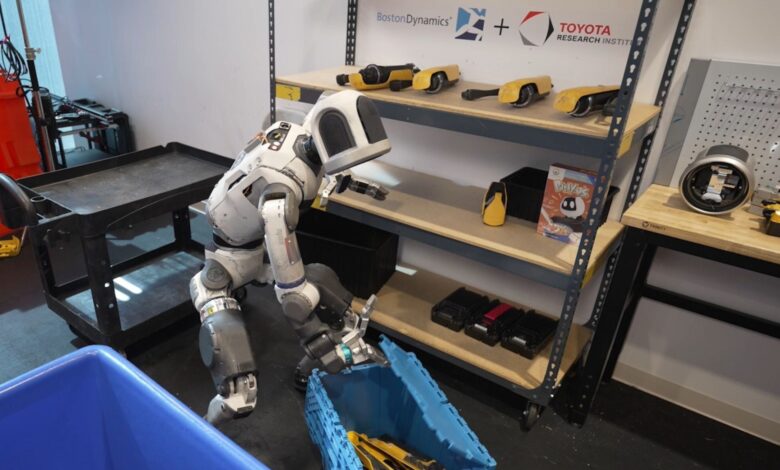
The video showed the Atlas humanoid carrying out inch-perfect human actions, albeit sluggishly. The robot was tasked with transferring a bunch of objects from one basket to another, and it didn’t disappoint.
Atlas first pulled the filled basket towards itself and opened it. Then, it started transferring all the objects into a larger basket. In the final stages of the video, Atlas is also seen picking up the objects, understanding how they were shaped so it could hold them properly and place them on a shelf.
The humanoid also showed capabilities of performing other human actions like walking, crouching, sorting, and organizing things.
“By adopting LBMs, new capabilities that previously would have been laboriously hand-programmed can now be added quickly and without writing a single new line of code,” Boston Dynamics said in a release.
Crossing the hurdles
Atlas performing human actions and tasks is commendable, but that’s not the whole story. The video also showed a person repeatedly disturbing the robot, while the latter finished its task despite the opposition.

“This work provides a glimpse into how we’re thinking about building general-purpose robots that will transform how we live and work,” said Scott Kuindersma, Boston Dynamics’ vice president of robotics research.
“Training a single neural network to perform many long-horizon manipulation tasks will lead to better generalization, and highly capable robots like Atlas present the fewest barriers to data collection for tasks requiring whole-body precision, dexterity, and strength,” he added.
Decoding the value proposition
“One of the main value propositions of humanoids is that they can achieve a huge variety of tasks directly in existing environments, but the previous approaches to programming these tasks simply could not scale to meet this challenge,” said Russ Tedrake, senior vice president of Large Behavior Models at Toyota Research Institute.
“Large Behavior Models address this opportunity in a fundamentally new way – skills are added quickly via demonstrations from humans, and as the LBMs get stronger, they require less and less demonstrations to achieve more and more robust behaviors,” he said.
Co-led by Kuindersma and Tedrake, the project aims to understand how big models can improve whole-body control, advanced movement, and manipulation.